Does This Sound Like Your Child?
Does your child…
- Struggle to read books at grade level even though they are bright and curious?
- Rely heavily on pictures to understand a story?
- Read common sight words inconsistently?
- Have trouble remembering and applying spelling rules?
- Get frustrated or refuse when asked to read for homework?
- Guess at words instead of sounding them out?
- Fail to recognize a word they just saw earlier in the same sentence?
- Read very slowly?
- Struggle to connect letters with their sounds?
- Understand stories much better when they are read aloud?
If you answered yes to several of these, your child may be among the estimated 5–10% of people who have dyslexia. This guide will help you understand what dyslexia really is, the signs to watch for, the myths that hold kids back, practical ways to support them, and — most importantly — the powerful strengths that often come with a dyslexic mind.
Key Takeaways
- Dyslexia is a language-based difference in how the brain processes written language — not a lack of intelligence or effort.
- Early recognition and the right instruction (especially structured literacy) make a profound difference.
- Many children with dyslexia develop remarkable strengths in creativity, big-picture thinking, resilience, and problem-solving.
- With proper support and accommodations, dyslexic learners can (and do) thrive academically and beyond.
- You are not alone, and help is available.
What Is Dyslexia?
Dyslexia is a specific learning disorder that primarily affects reading accuracy, fluency, and spelling. On a formal evaluation it is often listed as "Specific Learning Disorder with Impairment in Reading."
At its heart, dyslexia is a difference in the brain's wiring for language. Children with dyslexia usually have average or above-average intelligence and a strong desire to learn. Their brains simply process the sounds of language (phonemes) differently, making it harder to map those sounds onto letters and words.
This is why reading feels effortful even when a child is trying hard. The good news: the brain can build new pathways with the right kind of teaching. Dyslexia is lifelong, but it does not define a child's future. Many highly successful people in business, science, arts, and technology have dyslexia.
How Dyslexia Affects Language Processing
Reading requires breaking words into individual sounds (phonemes), blending them, and then recognizing larger meaningful units (morphemes). Children with dyslexia often struggle to hear where one sound ends and the next begins. As a result, they may:
- Sound out words slowly or inaccurately
- Rely on guessing from context or pictures
- Have trouble creating the "mental shortcuts" that make fluent reading automatic
This same challenge frequently appears in spelling (especially when writing sentences rather than isolated words) and in word retrieval — knowing a word but struggling to pull it out quickly in conversation.
Importantly, receptive vocabulary (understanding words) is often a strength. Many dyslexic children have rich spoken language and strong comprehension when material is presented orally. A device like a reading pen designed for dyslexia can help bridge that gap by reading printed text aloud on request, so comprehension isn't held back by decoding speed.
Common Characteristics by Age
Kindergarten – 2nd Grade
- Difficulty linking letters to sounds
- Phonetic spelling errors ("walkt" for walked)
- Letter reversals (common in all young children, but more persistent)
- Inconsistent reading of sight words
- Trouble with rhyming
- Guessing from pictures
- Strong ability to describe something but difficulty naming it
3rd – 5th Grade
- Reading below expected grade level
- Frustration or avoidance of reading tasks
- Preference for picture-heavy books
- Simple word choices in writing to avoid spelling risks
- Difficulty with reading comprehension as texts become more abstract
- Reluctance to read aloud
- Math word problems are harder than computation
Middle School & High School
- Accurate but slow reading
- Need to re-read for comprehension
- Difficulty keeping up with heavy reading loads
- Spelling challenges when technology is not available
- Trouble with foreign languages
- Time pressure on tests and homework
- Risk of lowered self-esteem if support is lacking

Managing and Supporting Dyslexia
Support works best when it matches the severity and the child's age.
Mild dyslexia
Often responds well to high-quality classroom instruction plus targeted tutoring 2–3 times per week using a structured literacy approach (Orton-Gillingham, Wilson, or similar programs). Accommodations such as extended time, audiobooks, and speech-to-text tools are usually enough for success.
Moderate to severe dyslexia
Benefits most from intensive, systematic, multisensory instruction — ideally daily. Some families choose specialized schools designed for dyslexia for 2–3 years of focused remediation, then transition back to mainstream settings with strong accommodations. When specialized schools are not available, intensive tutoring over several years is the next best option.
Helpful accommodations across ages include:
- Extended time on tests and assignments
- Access to audiobooks and text-to-speech
- Use of a computer with spell-check and speech-to-text
- Not being required to read aloud in front of peers
- Reduced foreign-language requirements when appropriate
- Testing in a quieter setting
At home, short, positive, multisensory practice sessions (10–15 minutes) make a real difference when paired with celebration of effort. For a closer look at how a scanning pen fits into an accommodation plan, our guide to which Scanmarker is right for your reader and this overview of scanning pens for dyslexia both walk through where the tool helps most.
The Powerful Benefits of a Dyslexic Mind
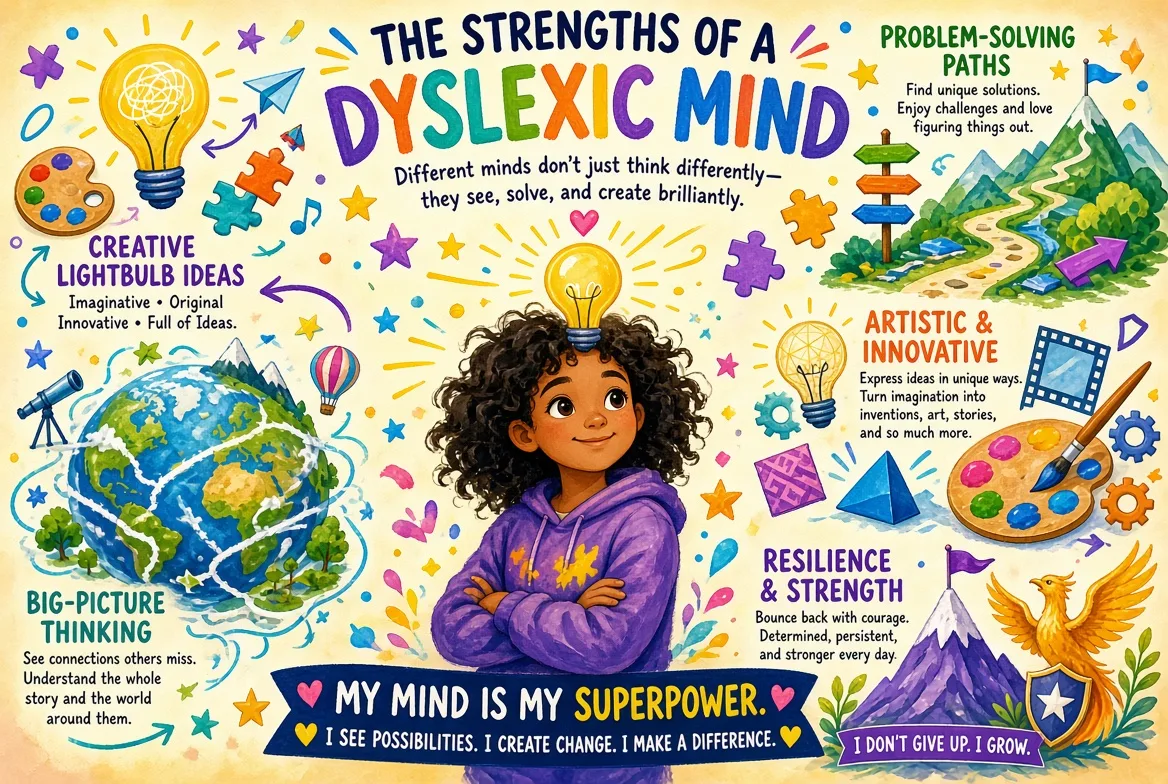
While school systems often emphasize linear, sequential thinking, many dyslexic brains excel at:
- Creative and lateral problem-solving
- Seeing the big picture
- Thinking outside conventional boxes
- Resilience and perseverance
- Empathy and understanding of others' struggles
- Strong reasoning and imaginative thinking
- Hands-on, spatial, and conceptual strengths (arts, design, engineering, entrepreneurship, science, sports, and more)
These are not consolation prizes — they are genuine advantages that many successful people credit for their achievements. When we stop trying to force a dyslexic brain into a one-size-fits-all mold and instead teach to its strengths while remediating reading, children flourish.
Common Myths — Busted
Myth: Dyslexia means reversing b's and d's.
Reality: Letter reversals can occur, but the core issue is difficulty with phonological processing — breaking words into sounds and blending them.
Myth: Children with dyslexia will never learn to read well.
Reality: With structured literacy instruction, most become accurate readers. Fluency may remain slower, which is why accommodations like extended time remain important.
Myth: Dyslexia means low intelligence.
Reality: Intelligence is independent of dyslexia. Many dyslexic individuals are highly intelligent and achieve at the highest levels.
Myth: Dyslexia mainly affects boys.
Reality: It occurs equally in boys and girls. Boys are more often identified earlier because they tend to show more external frustration.
Myth: Kids with dyslexia are just lazy.
Reality: They often work harder than their peers to produce the same output. The solution is not "try harder" — it is "try a different approach that matches how their brain learns."
Practical Next Steps for Parents
- Talk with your child's teacher and request information about reading progress and interventions already in place.
- Consider a comprehensive evaluation if concerns persist.
- Look for structured literacy tutors or programs.
- Explore accommodations through a 504 Plan or IEP.
- Celebrate your child's strengths daily and protect time for activities where they shine.
- Connect with reputable organizations such as the Yale Center for Dyslexia & Creativity and the International Dyslexia Association.
If you're at the stage of comparing tools and accommodations, our reading pen buyer's guide and this pen scanner buying guide both break down what to look for.
Closing Thought
Dyslexia is not a barrier to a successful, fulfilling life — it is a different way of thinking that, with the right support, can become a genuine advantage. When parents, teachers, and children understand the nature of dyslexia and focus on both skill-building and strengths, the path forward becomes clearer, more hopeful, and often surprisingly joyful.
You are already taking the most important step by seeking to understand. Your child is lucky to have you in their corner.